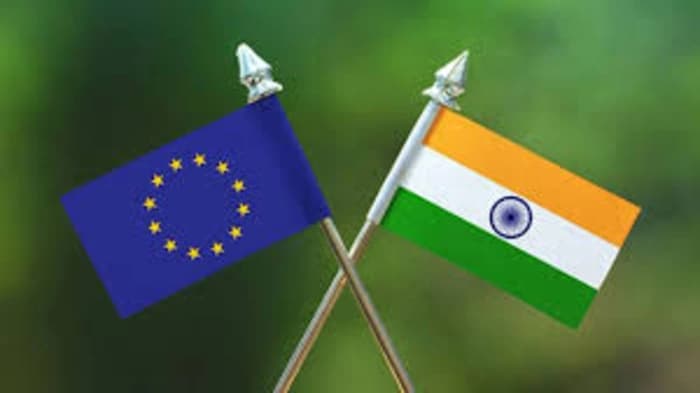
The relationship between India and the EU dates back to the early 1960s, with India being one of the initial nations to form diplomatic ties with the European Economic Community.
Connections established over time led to a formal Strategic Partnership in 2004 and the initiation of discussions for a Bilateral Trade and Investment Agreement, or India-EU FTA, in 2007.

FTA discussions came to a halt in 2013 after 15 rounds because of a "gap in ambition."
The EU aimed for market entry in sensitive areas such as wine, cheese, and spirits, whereas India focused on liberalizing trade in services and improving visa access.
In June 2022, negotiations for a Free Trade Agreement (FTA) were reinitiated between India and the European Union (EU).
Coverage
Negotiations for the India-EU trade agreement encompass 23 policy domains or chapters, such as Trade in Goods, Trade in Services, Investment, Sanitary and Phytosanitary Measures, Technical Barriers to Trade, Trade Remedies, Rules of Origin, Customs and Trade Facilitation, Competition, Trade Defence, Government Procurement, Dispute Resolution, Intellectual Property Rights, Geographical Indications, and Sustainable Development.
Current state of Trade Relations and Significance for India
In 2023-24, India’s goods trade with the EU reached $137.41 billion (exports – $75.92 billion, imports – $61.48 billion), establishing it as the largest goods trading partner.
The EU market represents approximately 17% of India's overall exports, whereas exports to India constitute 9% of its total exports.
Furthermore, the estimated bilateral trade in services between India and the EU in 2023 was $51.45 billion.
The two parties are discussing a free trade deal, a pact for investment protection, and an accord on geographical indications (GIs).
The trade pact with the EU would assist India in further broadening and diversifying its exports of products and services while protecting the value chains. India aims to create equitable agreements with significant global economies.
Main Concerns
Agriculture & Dairy: India enforces substantial tariffs (39%) to safeguard small farmers, whereas the EU advocates for entry to its dairy and agricultural goods.
The EU has suggested leaving agriculture out of the FTA to promote other industries.
Services & Mobility: India aims for Mutual Recognition Agreements (MRAs) for credentials and leniency in visa regulations.
The EU's limiting policies and denial of India's 'data secure' status under General Data Protection Regulation (GDPR) create obstacles for digital services trade.
Sustainability & CBAM: The EU's Carbon Border Adjustment Mechanism (CBAM)—a tax on carbon-heavy imports—has caused apprehension in India, particularly among MSMEs.
India condemns CBAM as unjust to developing nations and cumbersome because of its extensive data demands.
Sanitary and Phytosanitary (SPS) Measures: Although advancements have been made in various sectors, disagreements regarding food safety standards—particularly SPS measures—persistently obstruct the conclusion of the agreement.
EU’s Strict Regulations: The EU implements pesticide residue limits and aflatoxin levels that are more stringent than WHO Codex standards.
Effects on Indian Exports
India's coffee, tea, spices, and rice exports often encounter rejections because of these standards.
The increase in agricultural exports to the EU has been gradual, rising from $3.02 billion in FY2019 to $4.54 billion in FY2025.
Prospective Vision
India and the EU aim to finalize the FTA in two stages, with the initial stage focusing on areas of agreement by the conclusion of 2025.
The successful completion of the India-EU FTA will rely on mutual flexibility, gradual compromises, and practical strategies, particularly in sensitive sectors such as agriculture, services, and sustainability.
India and the EU might implement adaptable frameworks, similar to the EU’s FTAs with Singapore and Vietnam—gradual liberalisation or sector-specific exemptions.