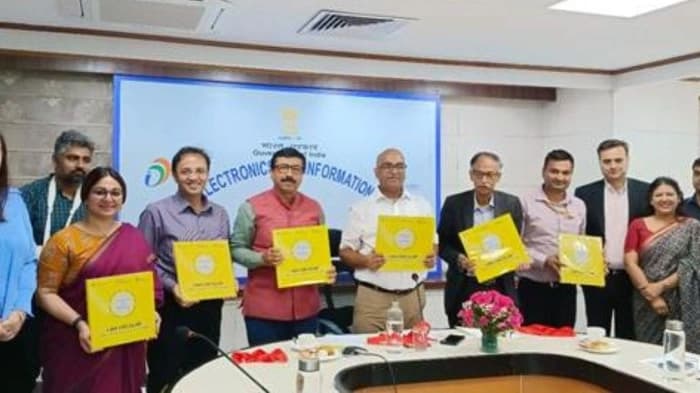
The 'I Am Circular' Coffee Table Book showcases 30 of India's most innovative solutions identified through the nationwide 'I Am Circular' Challenge. This initiative aims to uncover and promote groundbreaking solutions based on the principles of the circular economy.
The International Council for Circular Economy (ICCE), a non-profit organization established in 2020 in India, is committed to advancing the transition to a circular economy on both national and global scales. ICCE serves as a think tank, networking hub, and policy advocate, encouraging collaboration among industries, governments, academia, and civil society.

The circular economy (CE) is a production model that emphasizes the reduction or elimination of waste throughout the entire product life cycle, from the extraction of raw materials and manufacturing to disposal and reuse.
The core principles of the circular economy include designing products and systems to minimize or eliminate waste from the outset, maintaining products in circulation for as long as possible through reuse, repair, remanufacture, and recycling, and supporting the restoration of natural resources rather than depleting them, such as composting food waste to enhance soil quality.
The benefits of this approach include a reduction in environmental impact and pollution, conservation of limited resources, stimulation of innovation and new business models, and the potential to create new jobs and economic opportunities.
India's Circular Economy: A Promising Future - The advancement of India's circular economy presents significant opportunities for economic growth, job creation, and innovation centered on sustainability. It promotes environmental and resource efficiency by minimizing resource extraction and environmental harm, aligning with the UN Sustainable Development Goals (SDGs), the Paris Agreement, and the UN Decade on Ecosystem Restoration (2021-2030). Transitioning to a circular economy will improve systemic efficiency at both macro and industry levels, enhancing government and industry performance in sustainability metrics.
However, challenges remain, including a fragmented and inefficient waste infrastructure, limited incentives for the private sector to adopt circular economy practices, and the underutilization of the informal sector, which is not integrated into formal systems, leading to inefficiencies and health risks.
Key initiatives such as the Swachh Bharat Mission (SBM-U), which has achieved over 108% success in household toilet construction and processes 80.29% of solid waste, the GOBAR-Dhan Scheme promoting biogas and organic waste processing, and the E-Waste Management Rules (2022) aimed at improving electronic waste disposal practices, are crucial steps towards addressing these challenges and fostering a sustainable future.
The Circular Economy Cell (CE Cell) was established within NITI Aayog in 2022 as a specialized unit focused on advancing the Circular Economy. India is a participant in the Regional 3R and Circular Economy Forum in Asia and the Pacific, having hosted the 12th Regional 3R and Circular Economy Forum in March 2025.
This forum was initiated in 2009 to foster sustainable waste management, enhance resource efficiency, and promote the principles of a circular economy. India is at a pivotal moment where transitioning from a linear to a circular economy is not only essential for sustainability but also presents significant economic prospects. Given its increasing population, swift urbanization, and escalating consumption patterns, adopting circular economy practices can aid India in mitigating environmental harm, generating employment opportunities, and realizing economic benefits.
Nevertheless, this transition requires a holistic strategy that encompasses policy reforms, infrastructure advancements, technological progress, and inclusive practices that acknowledge the contributions of the informal sector.