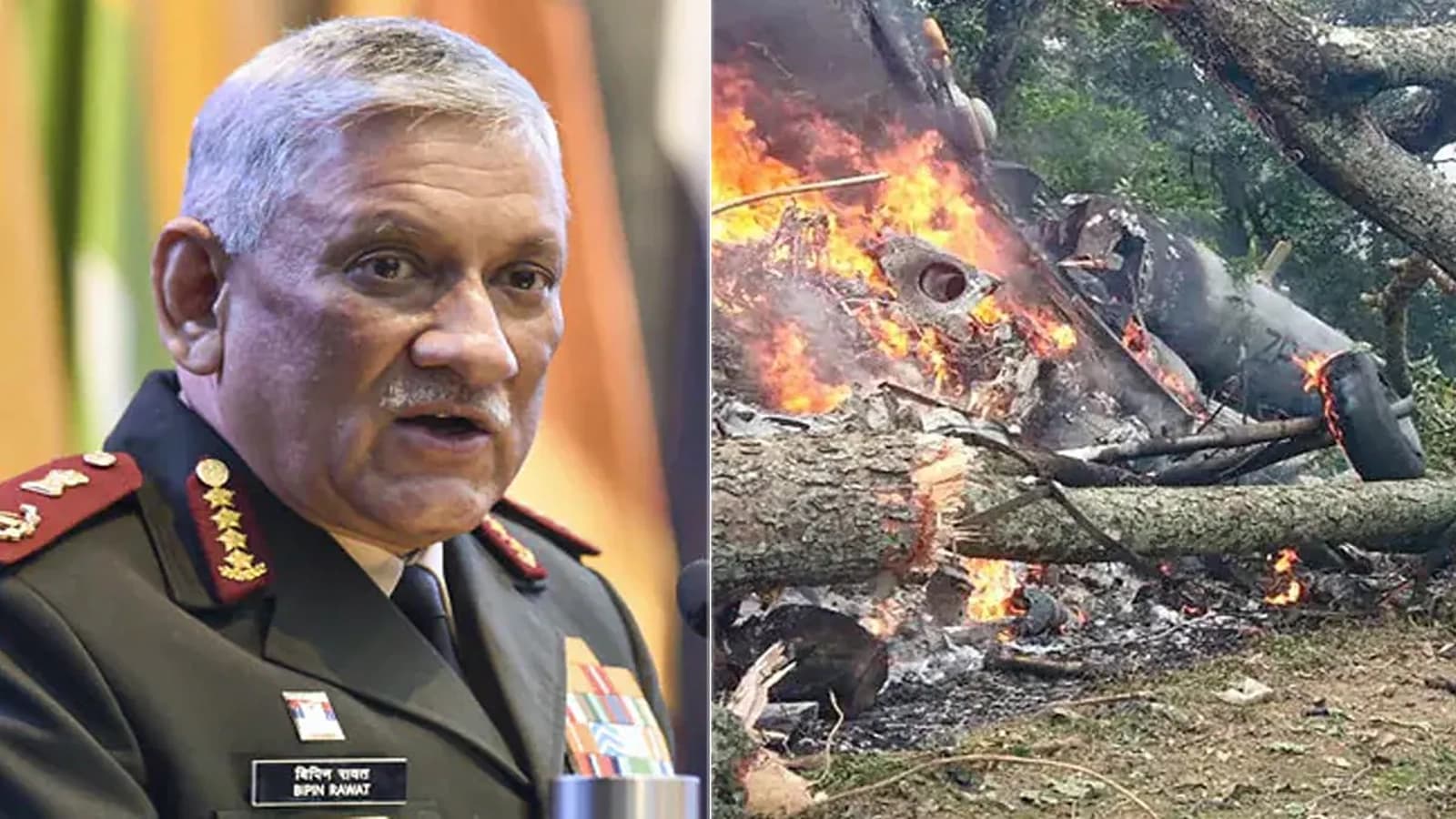
A recent report from the Parliamentary Standing Committee on Defence has concluded that the Mi-17V5 helicopter crash, which claimed the life of India’s first Chief of Defence Staff (CDS), General Bipin Rawat, was due to human error by the aircrew.
The accident, which occurred on Dec 8, 2021, near Coonoor in Tamil Nadu, also claimed the lives of Gen Rawat’s wife Madhulika Rawat and 12 others, including staff and crew members.

According to the committee's findings, 34 air crashes occurred during the 13th Five-Year Plan (2017-22), with 19 attributed to aircrew errors and nine linked to technical faults.
The report on the Demand for Grants for the three armed services was recently presented in Parliament.
Following the crash, the Indian Air Force (IAF) ordered a tri-services investigation led by Air Marshal Manvendra Singh, then Air Officer Commanding-in-Chief of Training Command.
On Jan 14, 2022, the IAF released preliminary findings stating that an “unexpected change” in weather conditions caused spatial disorientation, leading to a Controlled Flight into Terrain (CFIT).
The IAF clarified, "The Court of Inquiry (CoI) has ruled out mechanical failure, sabotage, or negligence as causes of the accident."
The Ministry of Defence further informed the House panel that 34 inquiries have been conducted since 2017. Recommendations from these investigations have focused on enhancing processes, procedures, training, equipment, operational practices, and maintenance protocols.
The Ministry stated that most corrective actions suggested by the Chief of the Air Staff have been implemented, with a few still underway.
The report highlighted a decline in crash rates from 0.93 per 10,000 flying hours in 2000-2005 to 0.27 in 2017-2022, further reducing to 0.20 for the 2020-2024 period, reflecting sustained efforts to improve flight safety and operational efficiency.