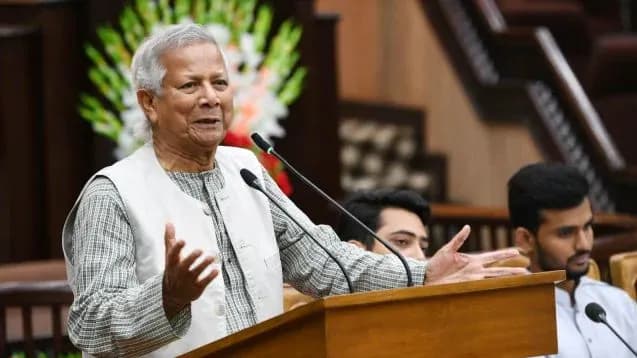
Bangladesh's interim government chief, Muhammad Yunus, has dismissed concerns over deteriorating relations with India, asserting that ties between the two nations remain strong despite recent tensions. Yunus, however, acknowledged the emergence of some conflicts but attributed them primarily to "misinformation and propaganda".
In an interview with BBC Bangla, the Chief Advisor emphasized the historical, political, and economic interdependence of Bangladesh and India, stating that their relationship is too deeply rooted to be fundamentally altered.

"There is no way Bangladesh-India relations cannot be good. Our ties are close, and our mutual dependence is high. However, some conflicts have arisen, and I have described them as clouds that appeared in the middle. These clouds have mostly come from propaganda, and it is up to others to determine the sources of such misinformation," he said.
The Chief Advisor assured that efforts were being made to clear the misunderstandings between Dhaka and New Delhi and reaffirm cooperation between the two neighbours.
On being asked whether Bangladesh is in direct contact with the Indian government, he confirmed ongoing diplomatic engagement.
"There is constant communication. Their representatives are visiting here, and our officials are travelling there. I personally spoke with Prime Minister Narendra Modi in the first week," he said, without elaborating on the specifics of the discussions.
India-Bangladesh relations have deteriorated sharply following the collapse of Sheikh Hasina's government amid mass student-led protests last August in which more than 1,000 people were killed. The subsequent caretaker administration, led by a Nobel laureate, has faced repeated criticism from India over its handling of attacks on Bangladesh's Hindu and other minority communities.
Meanwhile, Hasina, 77, has been living in India since August 5 last year after fleeing Bangladesh following the end of her 16-year regime.
Political parties in Bangladesh are calling for early elections and a return to democratic rule. Yunus has suggested that elections could be feasible by late 2025 but clarified he has no intention of running.