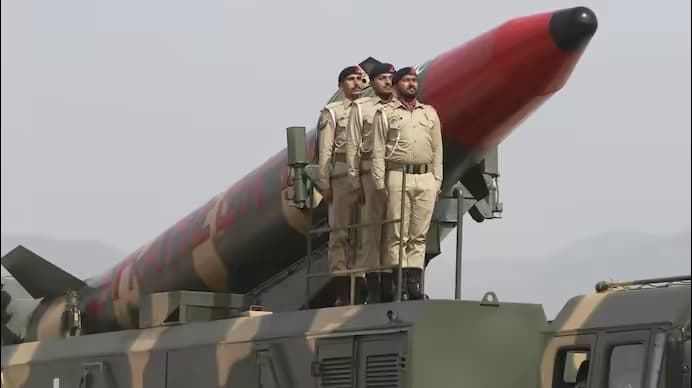
Pakistan is covertly developing a nuclear-capable intercontinental ballistic missile (ICBM) with a range that could strike the United States, according to a US intelligence assessment cited by Foreign Affairs.
The report warns that if Islamabad acquires such capability, Washington would be forced to officially consider Pakistan a nuclear adversary — placing it in the same league as Russia, China, and North Korea.

Despite decades of claiming its nuclear arsenal is India-focused, Pakistan is reportedly expanding its deterrence doctrine, emboldened by China's technical support and rattled by India’s recent Operation Sindoor — an offensive that obliterated multiple terror camps and strategic airbases deep inside Pakistani territory.
"Should Pakistan obtain an ICBM, the US will have no choice but to treat it as a nuclear threat. No nation with missiles capable of reaching American soil is seen as a friend," a US official told the publication.
ICBMs have ranges exceeding 5,500 km and can carry both nuclear and conventional payloads. Pakistan currently lacks such missiles but tested its longest-range weapon, the 2,700 km Shaheen-III, in 2022. Intelligence officials believe Pakistan’s pursuit of an ICBM is partly aimed at deterring a potential U.S. preemptive strike and dissuading American intervention in future Indo-Pak conflicts.
The U.S. has already slapped sanctions on Pakistan’s National Development Complex and other entities tied to missile development, citing efforts to acquire prohibited components. Islamabad dismissed the sanctions as “biased,” but American security agencies remain alarmed.
Adding to the unease, Pakistan — estimated to have 170 nuclear warheads — has not signed the Nuclear Non-Proliferation Treaty. And following reports of a hypersonic Fatah-II missile launch attempt during last month’s flare-up with India, Indian officials have called on the IAEA to monitor Pakistan’s nuclear arsenal more rigorously.
“This is a global concern,” said Defense Minister Rajnath Singh, warning that Pakistan cannot be trusted with weapons of mass destruction.