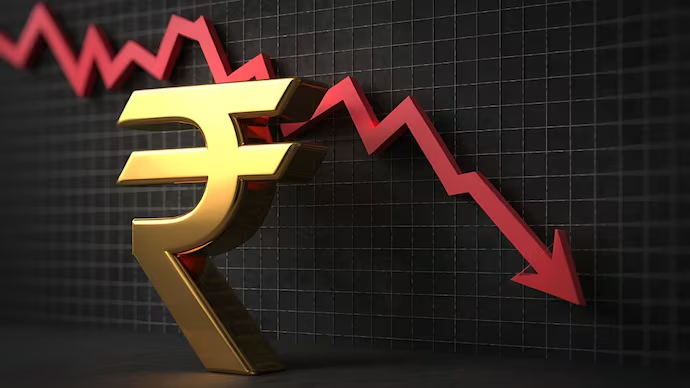
In 2025, the Indian rupee depreciated by about 4.7%, marking its worst annual performance in three years. It closed the year near ₹89.87 per U.S. dollar, making it the weakest-performing currency among major Asian peers.
Key Reasons for Depreciation
- Persistent foreign portfolio investor (FPI) outflows, driven by higher global interest rates and risk aversion.
- Trade uncertainty, particularly the absence of a comprehensive trade agreement with the United States, affecting export and investment sentiment.
- A strong U.S. dollar, supported by tight monetary policy in advanced economies.
- Elevated import bills, especially for energy and critical commodities, widening the current account deficit pressures.
Role of the RBI
- The Reserve Bank of India allowed greater exchange rate flexibility, intervening only to smooth excessive volatility rather than defend a specific level.
- This approach helped absorb external shocks while preserving foreign exchange reserves.
- RBI’s stance aligns with a market-determined exchange rate regime under a managed float system.
Economic Implications
- Positive:
- Enhances export competitiveness and supports services exports like IT and remittances.
- Negative:
- Increases imported inflation, particularly fuel and fertilisers.
- Raises the cost of external commercial borrowings and foreign debt servicing.
Way Forward
- Strengthening export diversification and value-added manufacturing.
- Attracting stable long-term capital flows such as FDI.
- Maintaining macroeconomic stability through fiscal prudence and inflation control.
Conclusion
The rupee’s depreciation in 2025 reflects broader global financial tightening and trade uncertainties rather than domestic macroeconomic fragility alone. A flexible exchange rate, combined with structural reforms and external sector resilience, remains key to managing future currency pressures.






%20Preeti%20Lobana%2C%20Sh.%20Jayant%20Chaudhary%2C%20Chris%20Phillips.jpeg&w=256&q=75)