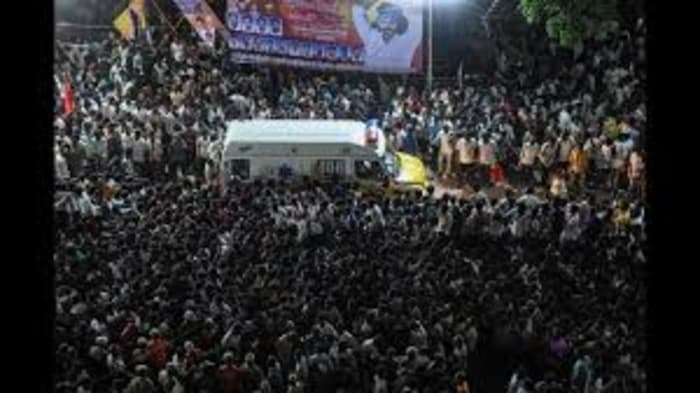
The rally had drawn a massive crowd; many estimates suggest the number of attendees exceeded official expectations.
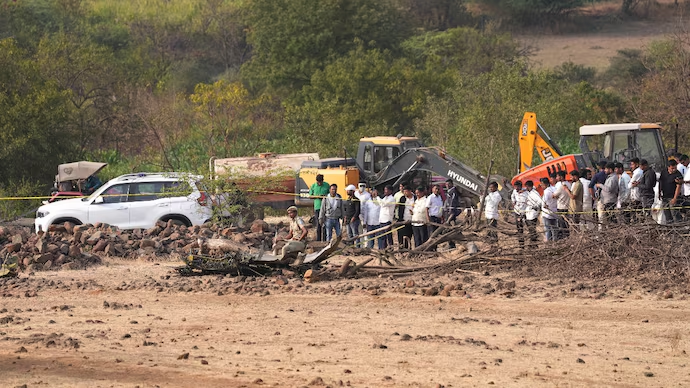
As of 28 September, about 40 deaths and over 80 injuries have been reported.

Such incidents expose gaps in crowd management, public safety protocols, accountability, and governance.
Key Issues & Analysis
1. Failures in Crowd Management & Safety Protocols
Insufficient planning for large turnout: the permitted capacity and actual crowd varied massively.
Delay in the scheduled event (Vijay’s arrival was reportedly delayed by many hours), which allowed the crowd to swell under adverse conditions (heat, lack of amenities) before proceedings.
Lack of staging, barriers, adequate entry/exit points, emergency routes and medical infrastructure for crowd overflow.
Communication failures: announcements, regulation, controlling surges were not effectively handled by organizers or law enforcement.
2. Accountability, Legal and Administrative Dimensions
Who is responsible? The event organizers (political party), local administration (district authorities, police), and oversight bodies all share responsibility.
Need for retrospective inquiry and legal action: forming a commission, judicial oversight, compensation, and prosecutions for negligence.
Role of standard operating procedures (SOPs) for public gatherings under the Disaster Management Act, police acts, etc.
3. Wider Implications & Patterns
India has a history of fatal crowd disasters in religious festivals, political rallies, pilgrim events — often due to similar structural failures.
Governance challenge: balancing mass political mobilization (free speech, public meetings) against public safety obligations.
Public trust is undermined when such tragedies occur, especially if accountability is weak or delayed.
4. Preventive Strategies & Best Practices
Pre-event risk assessment and crowd modeling: using data, simulations, expected turnout, weather, etc.
Infrastructure & layout design: adequate exit/entry points, spacing, barricades, open areas, controlled ingress.
Monitoring & control systems: CCTV, drones, crowd sensors, real-time feedback, command & control centers.
Training & coordination: training for police, volunteers, emergency services; coordination among police, municipal agencies, health, fire services.
Public awareness & communication: clear signage, announcements, crowd direction, continuous feedback to the crowd if delays or changes occur.
Legal / regulatory reforms: enforce strict licensing and permissions for mass gatherings, mandatory safety audits, penalties for violations.
Conclusion / Way Forward
The Karur tragedy is a chilling reminder that mass events — be they political, religious, or cultural — carry inherent risks and demand rigorous planning, institutional discipline, and accountability. Going forward:
States must mandate detailed crowd safety protocols for large gatherings, and no event should be held without compliance.
Investigations must be transparent, victims must receive timely compensation, and lessons must be institutionalized.
A national-level framework or law (if not existing) might be formulated to regulate large public assemblies uniformly across states.
Political parties and civil society must internalize the responsibility: public mobilization cannot come at the cost of human lives.