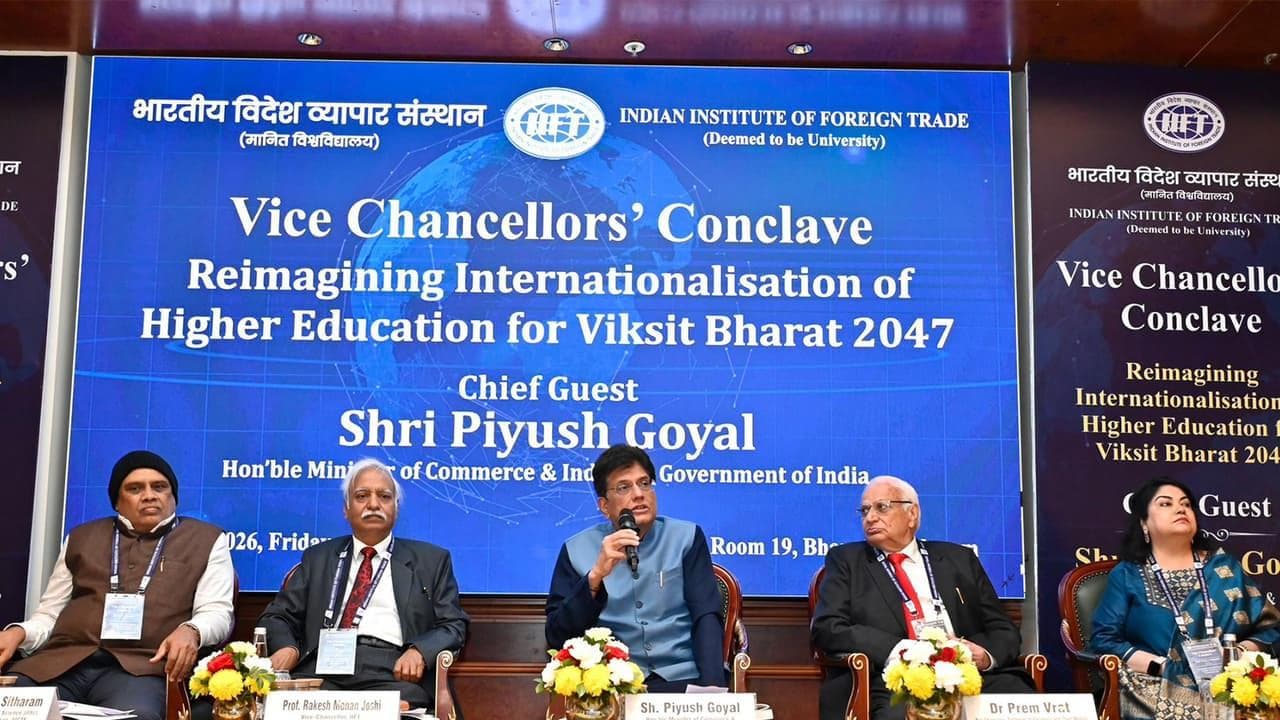
Education services could emerge as a major contributor to India’s export earnings while also helping expand the international footprint of Indian universities, Commerce Minister Piyush Goyal said on March 6.
Speaking at the Vice Chancellor's Conclave on "Reimagining Internationalisation of Higher Education for Viksit Bharat 2047," Goyal welcomed efforts by the Ministry of Commerce and the Indian Institute of Foreign Trade to examine how education services can strengthen India’s export sector and promote Indian institutions globally.

The conclave brought together academic leaders and policymakers to discuss ways to expand the international engagement of Indian higher education. Deliberations covered topics such as global academic collaborations, cross-border student mobility, regulatory frameworks, and dual degree programs.
Participants also discussed measures to improve the global competitiveness of Indian higher education institutions and assessed opportunities arising from the growing international market for education services.
Goyal said developing economies such as India are likely to play a larger role in driving global economic growth in the coming years. Exposure to India, he said, would therefore benefit students from developed countries as they prepare for their professional careers.
He highlighted that this trend is increasingly visible during negotiations related to the services component of Free Trade Agreements.
According to the minister, the nine FTAs finalized by the government led by Prime Minister Narendra Modi have all been concluded with developed economies. As a result, nearly two thirds of global trade is now covered through India’s trade agreements.
He said this reflects a shift in India’s engagement with the global economy, adding that the country now negotiates with greater confidence rather than from what he described as a colonial-era mindset.
"If India is currently contributing around 20% of global growth and has emerged as an engine of growth, then in the future the younger generations across the world will increasingly need to work with countries such as India," he said.
Goyal also highlighted the reforms introduced through the National Education Policy 2020, noting that the policy was prepared after extensive consultations with educationists and stakeholders across India and abroad.
He said nearly three lakh suggestions and responses were received during the consultation process and were carefully examined before the policy was finalized.
According to the minister, the policy encourages Indian institutions to pursue international standards, expand academic capacity, and attract students from around the world.
It also allows foreign universities to establish campuses in India and promotes collaboration between Indian and overseas institutions to offer dual degree programs.
He said such collaborations will help Indian students gain global exposure while also bringing international students to Indian campuses.
Goyal suggested that universities could consider academic models where international students spend part of their course in India and the rest in their home institutions, allowing them to better understand the culture, society, and working environment of developing economies.
Addressing vice chancellors attending the conclave, he described them as key contributors to shaping the country’s future by preparing students to meet emerging global challenges.
The minister said universities and teachers must continuously update their knowledge and teaching methods to remain aligned with modern academic and industry requirements.
According to him, outdated curricula cannot prepare students for the future, and institutions must remain responsive to emerging opportunities.
He also emphasized the growing importance of areas such as artificial intelligence, quantum computing, and machine learning, saying these technologies will be critical for sustaining India’s economic growth.
Goyal said academic programs should include subjects related to international trade and India’s Free Trade Agreements so that students can better understand opportunities in the global economy.
He expressed confidence that students with knowledge of international law, trade rules, and global agreements will help advance India’s goal of becoming a developed nation during the Amrit Kaal.
Goyal added that improvements in infrastructure, teaching methods, and global engagement could encourage more students to pursue higher education in India.
He said the present ratio of 28 Indian students studying abroad for every one international student studying in India should eventually reverse, with India aiming to attract around 1.3 million foreign students while fewer Indian students go abroad.
The minister concluded by urging stronger collaboration between academia, government, and industry to advance the internationalization of higher education and position India as a global education destination by 2047.