Indian-origin researcher based in the United States has received a new international science award for work that links climate data with real-world decisions made by farmers facing environmental stress.
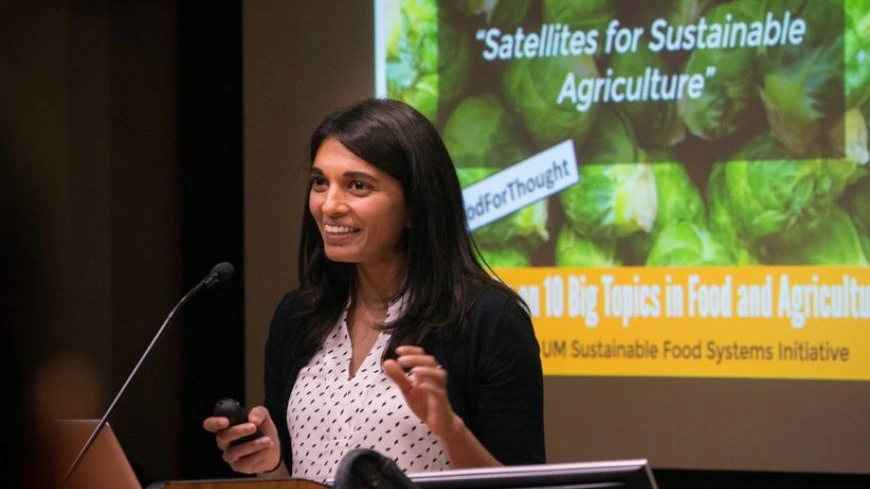
Meha Jain, an associate professor at the University of Michigan’s School for Environment and Sustainability, has been named the first recipient of the Arizona State University–Science Prize for Transformational Impact. The global award recognizes early-career scientists whose research demonstrates measurable benefits for society.

The award committee highlighted Jain’s use of satellite imagery and artificial intelligence to analyze how smallholder farmers adapt to climate pressures such as rising temperatures and erratic rainfall.
Her work tracks changes in irrigation methods, cropping cycles, and land use patterns, offering insight into farmer behavior that goes beyond traditional crop yield assessments.
Researchers said her findings also reveal environmental trade-offs linked to adaptation, particularly the long-term depletion of groundwater in heavily cultivated regions.
By documenting these patterns, Jain’s research connects climate resilience with sustainability risks that are often overlooked in policy planning.
The ASU–Science Prize marks its inaugural year, placing Jain among a small group of scientists whose work bridges advanced research and on-the-ground impact.
Jain completed her academic training at Princeton University and Columbia University, earning a PhD in ecology and environmental biology, and later conducted postdoctoral research at Stanford University.
Using a combination of remote sensing, machine learning, and field surveys, Jain has mapped irrigation use and cropping patterns across regions where official agricultural data is limited or outdated. Her findings have questioned policy narratives that frame resource depletion primarily as a failure of information.
In addition to academic publications in journals such as Science and Nature Sustainability, Jain is focused on applying research outcomes directly.
She is developing smartphone-based tools designed to help farmers make informed decisions on irrigation timing, crop selection, and climate risk management.
As climate change increasingly affects food systems, researchers said Jain’s work demonstrates how technology can support agricultural adaptation while also signaling the ecological boundaries policymakers must address.
The ASU–Science Prize recognizes research that converts data into actionable insights, with farmers placed at the center of the process.