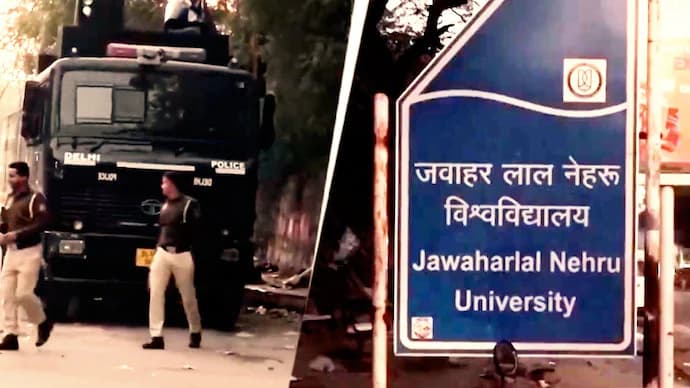
Tensions at Jawaharlal Nehru University spilled onto the streets on February 26 as a student-led march toward the Ministry of Education turned violent, leaving both police personnel and students injured and triggering detentions, arrests, and multiple FIRs.
According to police, between 400 and 500 students defied an advisory against protesting outside campus and began what they described as a “Long March” to press for implementation of University Grants Commission (UGC) norms, rollback of recent rustications of student leaders, and enactment of the proposed Rohith Act.

By mid-afternoon, the march reached the university’s main gate, where barricades had been set up by the police. What followed was a chaotic confrontation.
Barricades breached, injuries reported
Police alleged that protesters pelted banners and sticks, threw shoes, and physically assaulted personnel. A senior officer was quoted as saying by PTI new agency that barricades were damaged as tensions escalated and claimed that some officers were bitten during the scuffle.
Around 25 police personnel, including senior officers, were reported injured. Students, however, accused the police of using excessive force and manhandling protesters, claiming several students sustained injuries in the crackdown.
Videos circulating from the protest appeared to show scuffles between demonstrators and police, including visuals of sticks being thrown and personnel being pushed. In one clip, a student was seen allegedly slapping a police officer; in another, a protester appeared to climb a wall inside the campus and address the crowd. The authenticity of the videos could not be independently verified.
Detentions, arrests and court intervention
More than 51 students were detained, and 14 were formally arrested the following morning. An FIR was registered at Vasant Kunj North police station under sections related to obstruction, assault and common intention.
Those arrested were produced before the court at Patiala House Court, where the prosecution argued that the protest was not peaceful and that officers had suffered injuries during the clash. It also cited previous instances of protests and said four FIRs had been registered earlier in connection with campus unrest.
The court observed that assault on police officials “is serious and cannot be permitted under the garb of a peaceful protest.”
During the hearing, a female student alleged that she was dragged by men in plain clothes, leaving her injured. Another accused contested the police claim that the group was heading toward India Gate, stating that the march was directed at the Ministry of Education.
Students allege ‘undisclosed’ detention locations
The students’ union claimed that some detainees were taken to “unconfirmed locations,” a concern echoed by the teachers’ association, which sought clarity on the whereabouts and well-being of those detained.
The Jawaharlal Nehru University Students' Union also alleged that a portrait of B R Ambedkar was damaged during police action, though the university administration did not confirm the claim.
In its official statement, the university said that the protest demand for implementation of UGC regulations was in violation of a stay issued by the Supreme Court, and asserted that the Vice-Chancellor and Registrar had no authority over the regulations. It added that disciplinary action against certain students followed a proctorial inquiry into alleged vandalism and violence on campus.
The administration further stated that as a public university, it is accountable to the government and taxpayers, and condemned what it described as attacks on its leadership over disciplinary decisions.
A day of escalation
The confrontation followed a day of mounting tension:
- 11 am: Students alleged deployment of the Rapid Action Force inside campus.
- 12 pm: Call for protest issued.
- 3 pm: March began.
- 4 pm: Protesters reached the main gate.
- 4:15 pm: Tussle with police began.
- 4:30 pm: Detentions started.
- 10:30 pm: FIR registered under non-bailable sections.
- Next morning: 14 protesters formally arrested and produced in court.
A campus at crossroads
The latest clash underscores the widening rift between student groups and the administration over disciplinary action, campus governance, and the implementation of national education regulations.
For now, the battle has shifted from the barricades to the courtroom — but the fault lines at JNU remain raw, unresolved, and increasingly volatile.