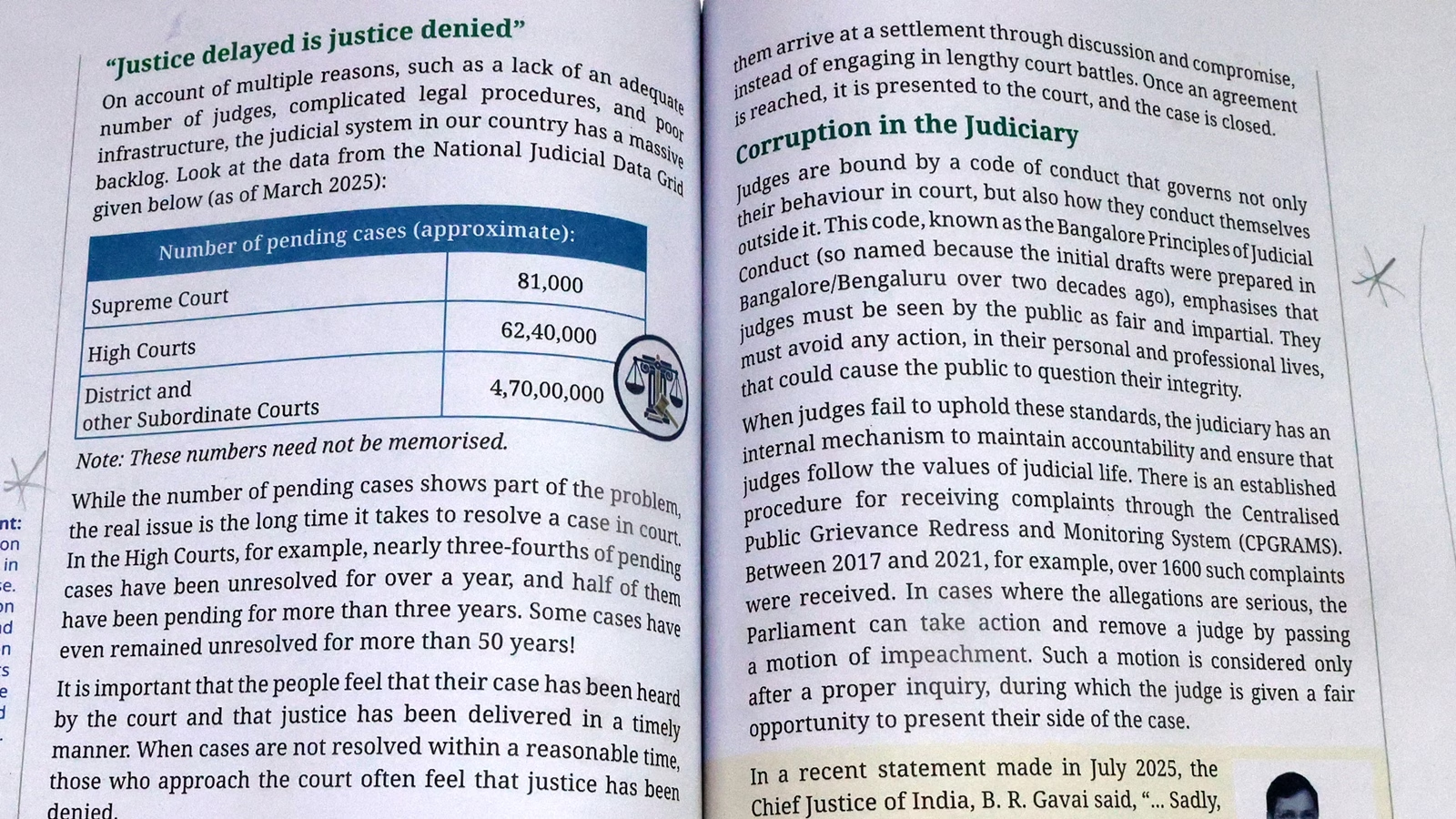
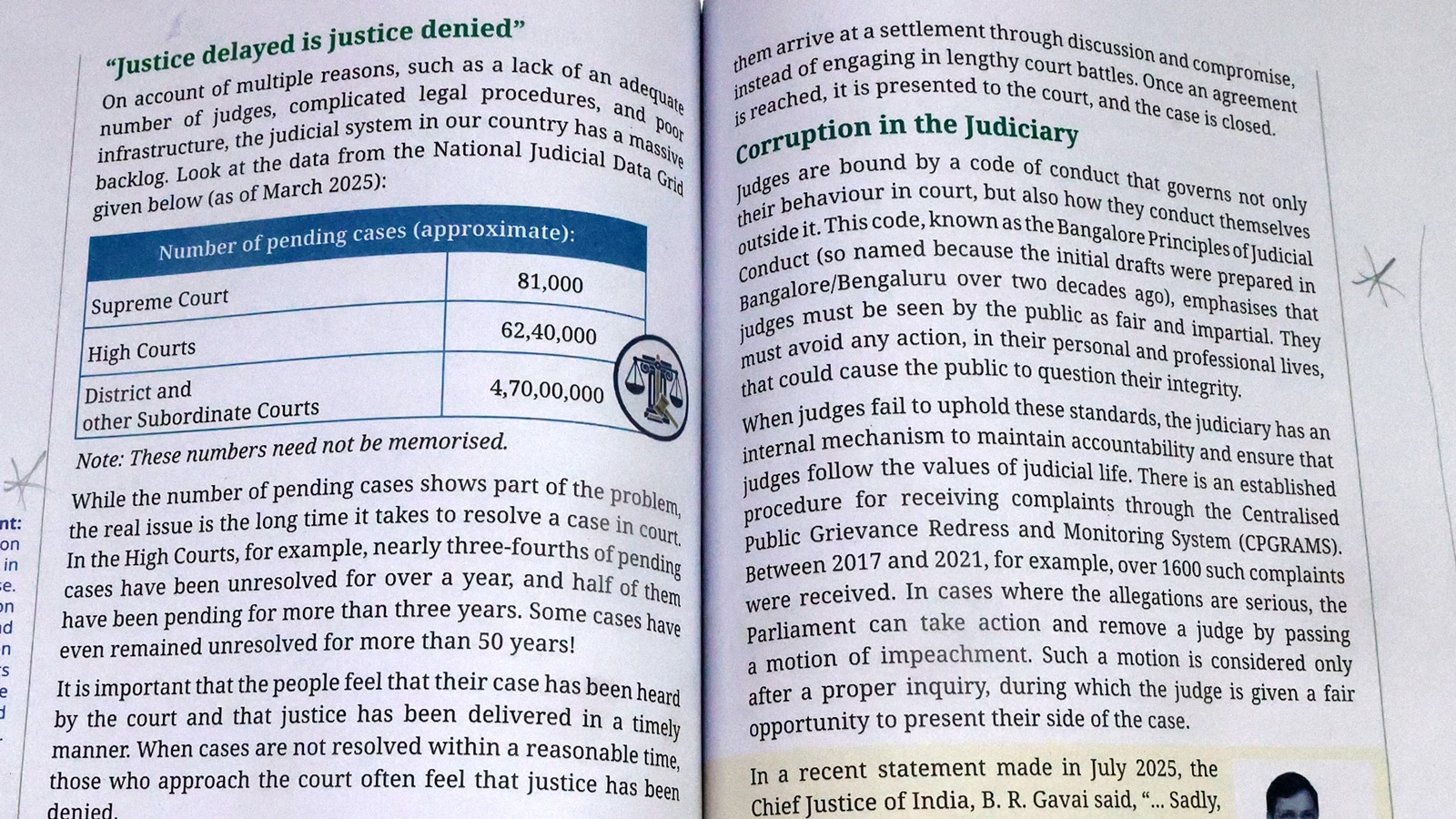
In a significant shift in tone and content, the National Council of Educational Research and Training (NCERT) has, for the first time, explicitly flagged “corruption in the judiciary” and a “massive backlog” of cases as key challenges confronting India’s justice delivery system in its newly released Class 8 Social Science textbook.
The revised chapter, titled The role of the judiciary in our society, lists “corruption at various levels of the judiciary” and mounting pendency driven by “a lack of an adequate number of judges, complicated legal procedures, and poor infrastructure” among systemic concerns.

Over 5.3 crore cases pending
The textbook places the scale of the crisis in stark numbers. It cites approximately:
- 81,000 pending cases in the Supreme Court of India
- 62,40,000 in High Courts
- 4,70,00,000 in District and Subordinate Courts
Taken together, the figures point to a staggering pendency of over 5.3 crore cases across the judicial hierarchy.
Earlier editions of the Class 8 textbook, framed under the National Curriculum Framework (NCF) 2005, confined themselves largely to explaining the structure of the judiciary, the meaning of judicial independence, and access to courts. While they acknowledged delays — invoking the phrase “justice delayed is justice denied” — they stopped short of referencing corruption within the system.
Code of conduct and complaints mechanism
The new text underscores that judges are bound by a code of conduct governing their behavior both inside and outside courtrooms. It outlines internal accountability mechanisms and refers to the Centralized Public Grievance Redress and Monitoring System (CPGRAMS) as an established channel for complaints, noting that over 1,600 complaints were received between 2017 and 2021.
In cases involving serious allegations, the book explains, Parliament may initiate impeachment proceedings. Such a motion is taken up only after a proper inquiry, during which the judge is given a fair opportunity to present their case.
“Nevertheless, people do experience corruption at various levels of the judiciary,” the text states, adding that for the poor and disadvantaged, such experiences can further impede access to justice. It notes ongoing efforts at both State and Union levels to strengthen transparency, deploy technology, and take “swift and decisive action” where required.
CJI Gavai quoted on public trust
The textbook also cites former Chief Justice of India B R Gavai, who in July 2025 acknowledged instances of corruption and misconduct within the judiciary, warning that such episodes erode public confidence.
“Transparency and accountability are democratic virtues,” he is quoted as saying, emphasizing that restoring faith depends on prompt and transparent corrective action. Any erosion of confidence, he cautioned, risks weakening the judiciary’s constitutional role as the ultimate arbiter of rights.
Electoral bonds and IT Act rulings
In a section examining why an independent judiciary is essential, the book invites students to analyse two major judicial interventions.
On electoral bonds, it explains that the scheme — introduced in 2018 to enable anonymous political donations — was struck down by the Supreme Court as unconstitutional, with the court holding that voters have a right to know the sources of political funding.
On amendments to the Information Technology Act, it recounts how a clause introduced after 2009 allowed imprisonment for certain online posts. In 2015, following a challenge by a law student, the Supreme Court invalidated the provision, ruling that it violated the constitutional guarantee of free speech.
Students are asked to reflect on what the court did in each instance and why — reinforcing the judiciary’s role as a constitutional safeguard.
Textbook overhaul under NEP
The new book is part of a broader curriculum revamp aligned with the National Education Policy (NEP) 2020 and the National Curriculum Framework for School Education. NCERT has so far released new textbooks for Classes 1 to 8, with the first part of the Class 8 Social Science text having been issued in July last year.
The earlier textbooks were “rationalized” during the Covid-19 pandemic to reduce content load. The latest edition marks a departure — not merely in structure, but in candour — by placing systemic judicial challenges before middle school students in unambiguous terms.