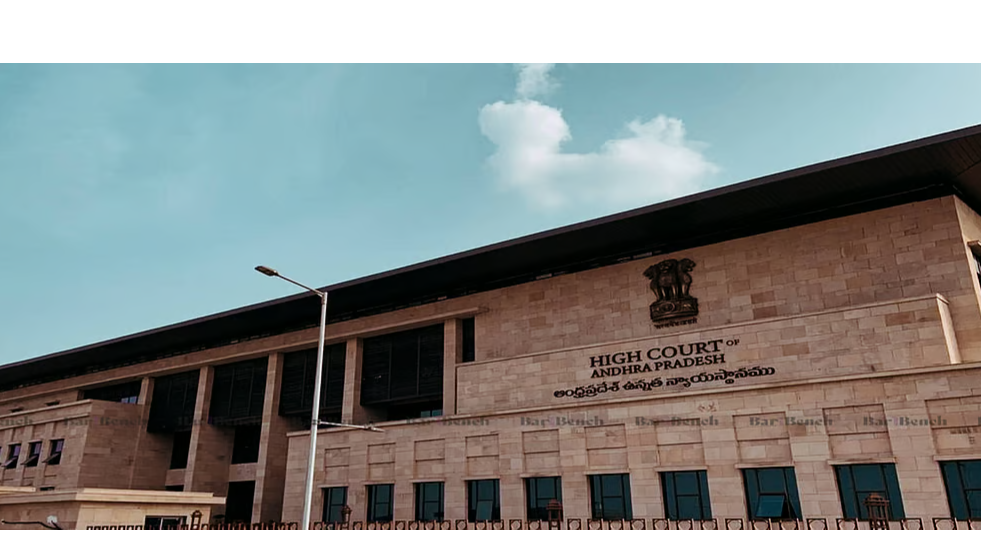
Emphasizing that universities are “temples of higher education” and not revolving doors for temporary employment, the Andhra Pradesh High Court has ruled that ad-hoc or contractual teachers performing duties identical to regular faculty against sanctioned posts cannot be replaced by another set of temporary appointees.
In a significant judgment reinforcing academic stability and fair employment practices, Justice Maheswara Rao Kuncheam held that the frequent engagement and disengagement of assistant professors on an ad-hoc basis directly impairs the quality of education and undermines the constitutional mandate of the State.

The court directed that the petitioner—an assistant professor who challenged a university circular proposing fresh temporary appointments—shall be allowed to continue in service until a regularly selected candidate is appointed through due process, provided student enrolment justifies the post.
“Universities are temples of learning where continuity, academic stability and sustained teacher–student engagement are essential for maintaining standards of higher education,” the court observed in its order dated January 31.
The ruling came while hearing a petition filed by P Nagaraju, an Assistant Professor in Management at Rayalaseema University, who assailed a 2017 circular seeking to recruit new temporary teaching assistants despite his long-standing contractual service.
The court noted that replacing one ad-hoc or contractual employee with another amounts to an abuse of the contractual system and perpetuates temporary employment for work that is perennial and essential in nature. Such practices, it said, defeat the very object of regular recruitment and violate the principles of fairness and equality enshrined in the Constitution.
Drawing a clear distinction, the High Court clarified that contractual appointments may operate only as a temporary bridge until a regularly selected candidate is appointed. Once the requirement of a post is shown to be ongoing and indispensable, successive temporary appointments cannot be legally justified.
“Ad-hoc teachers discharging duties identical to those of regular faculty cannot be treated as disposable resources, subjected to recurring insecurity of tenure and livelihood,” the court said, adding that such a system not only undermines the dignity of labour but also erodes institutional memory and academic excellence.
The judgment underscored that education is not a discretionary administrative function of the State but a binding constitutional obligation, intrinsically linked to the nation’s future under Article 21-A (Right to Education). The court further held that Articles 14, 21 and 21-A obligate the State to balance students’ right to quality, stable education with non-arbitrary and fair employment practices.
Allowing universities to indefinitely avoid regular recruitment, the court warned, would result in arbitrary employment systems and deny eligible candidates a fair opportunity to compete for permanent posts—an outcome that “cannot be sustained in law.”
Case background
The petitioner, who has served as a contract lecturer for nearly 11 years, was initially appointed in 2006 through a duly constituted selection committee following a public notification. He was later transferred to the PG Centre at Kurnool, where he continued to function as an assistant professor on a contractual basis.
Arguing the case, counsel for the petitioner, advocate P V Krishnaiah, contended that a temporary employee cannot be replaced by another temporary employee in the absence of regular recruitment. On the other hand, counsel for the university submitted that the petitioner’s services were no longer required following the appointment of regular faculty and redistribution of workload.
Rejecting this contention, the High Court reaffirmed that continuity in teaching and institutional stability cannot be sacrificed at the altar of administrative convenience.