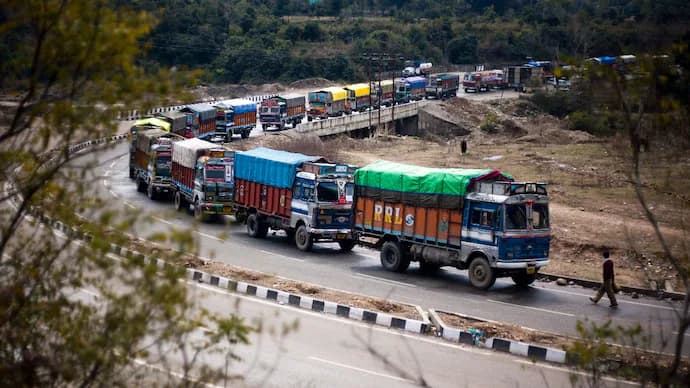
India moves billions of tonnes of goods each year. From cement and coal to groceries and gadgets, freight is the invisible engine powering the economy. But the backbone of that system—long-haul trucks thundering across highways day and night—is also emerging as one of the country’s biggest pollution culprits.
A new report by Smart Freight Centre India, The Energy and Resources Institute, and Indian Institute of Management Bangalore lays bare a stark imbalance: trucks account for just 3% of all vehicles on Indian roads, yet they generate a staggering 53% of particulate matter emissions from the road transport sector.

The findings go further. Heavy vehicles are responsible for over 60% of black carbon emissions and more than 70% of nitrogen oxides (NOx) from road transport—pollutants directly linked to respiratory disease, heart conditions, and premature deaths.
And the trajectory is worrying. In a business-as-usual scenario, emissions from medium and heavy-duty vehicles are projected to rise from 27% of total road transport emissions in 2019–20 to 35% by 2030–31. Over the same period, India’s freight demand is expected to nearly triple.
Why trucks pollute so much
The reasons are structural—and entrenched.
India’s heavy freight fleet runs overwhelmingly on diesel. A significant share of these trucks are more than a decade old, operating with outdated engines and limited emission controls. According to the report, vehicles older than 10 years account for a disproportionate share of black carbon and particulate emissions within the heavy-duty segment.
The impact is not evenly spread. Freight corridors and industrial belts experience concentrated bursts of PM and NOx emissions, creating toxic pollution hotspots that citywide air quality averages often fail to capture. For residents and workers along these routes, exposure is chronic and intense.
The data blind spot crippling climate action
Despite freight’s outsized pollution footprint, emissions from the sector are barely tracked.
Of 800 companies reporting under SEBI’s mandatory Business Responsibility and Sustainability Reporting (BRSR) framework, only 7% disclose freight-specific emissions. Even among those that do, there is little consistency.
The report highlights one striking example: a single cement company’s freight emissions, calculated across five global reporting frameworks, ranged from 265 to 3,000 thousand tonnes of CO₂ annually. That four-fold variation is not a statistical anomaly—it reflects systemic inconsistencies that render freight-related climate disclosures unreliable.
Sagar Kadu of India’s Ministry of Commerce and Industry underscored the urgency of reform, arguing that freight emissions accounting must be integrated into broader logistics planning to support efficiency, competitiveness, and sustainability simultaneously.
A national roadmap — and a common yardstick
The report proposes a solution grounded in standardization.
At present, companies measure freight emissions using different methodologies—effectively using different “scales” in the same marketplace. The authors recommend adopting International Organization for Standardization’s ISO 14083 standard for transport emissions, calibrated with India-specific emission factors that reflect real-world freight movement across highways and state corridors.
“You cannot decarbonise what you cannot measure,” said Deepali Thakur of Smart Freight Centre India, stressing that standardised methodologies would enable targeted, evidence-based interventions.
Uniform measurement would allow companies to identify their most polluting routes, optimise logistics, and generate verifiable carbon reductions. Those reductions could potentially be monetised under India’s Carbon Credit Trading Scheme, creating financial incentives for cleaner freight operations.
The global trade penalty India cannot ignore
The cost of inaction extends beyond smog-filled skies.
With the European Union’s Carbon Border Adjustment Mechanism (CBAM) coming fully into force in 2026, exporters must account for the carbon embedded in their products—including emissions from transport. Failure to provide credible data could result in penalties at European borders.
For Indian exporters dependent on road freight and lacking reliable emissions accounting, this poses a direct threat to competitiveness in one of the world’s largest markets.
Domestically, the consequences are already visible: rising hospital admissions, lost productivity, and the slow degradation of air quality in towns lining India’s freight arteries.
A solvable crisis—if addressed now
The report does not frame freight pollution as an unsolvable dilemma. Instead, it presents it as a measurable, manageable challenge—provided India acts swiftly to modernise its fleet, standardise emissions accounting, and align freight growth with climate responsibility.
Trucks may represent only 3% of India’s vehicles. But unless urgently addressed, their environmental impact will continue to define the country’s air quality, public health burden, and global trade standing in the decades ahead.