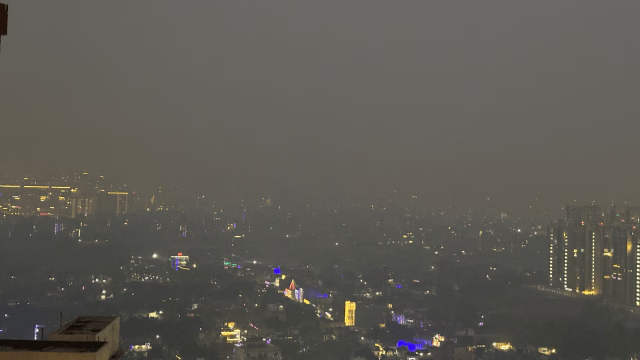
A day after Diwali celebrations lit up the night sky, Delhi woke up under a suffocating haze on October 21 morning, with pollution levels soaring into the ‘very poor’ and ‘severe’ categories across the National Capital Region (NCR). The city’s average Air Quality Index (AQI) stood at a hazardous 346 at 5:30 am, leaving the capital shrouded in toxic smog.
According to the Central Pollution Control Board (CPCB), 36 of Delhi’s 38 monitoring stations recorded AQI readings in the red zone late Monday night, marking one of the worst post-Diwali mornings in recent years. Despite the use of so-called “green” firecrackers following the Supreme Court’s conditional relaxation, the air quality nosedived across the capital and its suburbs.

Red-zone readings dominate Delhi
Several localities breached the 400 mark — the threshold for ‘severe’ air quality.
- Bawana: 418
- Wazirpur: 408
- Jahangirpuri: 404
- Burari Crossing: 393
- Ashok Vihar: 386
- RK Puram: 369
- Anand Vihar: 352
- ITO: 345
Even traditionally cleaner areas like Pusa and Dwarka reported AQI above 330, underscoring the widespread impact of pollution.
NCR gasps for breath
The crisis extended far beyond Delhi’s borders. According to private air-quality tracker aqi.in, Noida, Ghaziabad, and Faridabad all recorded AQI readings above 410, while Gurgaon stood at 402 and Greater Noida at 390. Meerut fared slightly better, but still recorded an alarming 302.
A toxic mix of factors
Officials attributed the pollution spike to firecracker smoke, stubble burning in neighboring states, and vehicle emissions — a lethal combination that routinely traps Delhi in a grey haze each winter. The Early Warning System for Delhi has cautioned that conditions may deteriorate further over the next 48 hours due to low wind speeds and falling temperatures.
Health warnings issued
Public health experts have advised residents — especially children, the elderly, and those with respiratory conditions — to avoid outdoor activities and use N95 masks when stepping out. Authorities have urged people to work from home where possible and refrain from morning walks until the AQI dips to at least the ‘moderate’ range.
The grim numbers
The Air Quality Index scale categorises pollution levels as:
- Good (0–50)
- Satisfactory (51–100)
- Moderately Polluted (101–200)
- Poor (201–300)
- Very Poor (301–400)
- Severe (401–500)
The World Health Organization (WHO) recommends a 24-hour limit of 15 μg/m³ for PM2.5 and 45 μg/m³ for PM10, levels that Delhi has exceeded many times over.
As the post-Diwali haze thickens, Delhi-NCR once again finds itself battling an all-too-familiar foe — a toxic cocktail of celebration, smoke, and systemic neglect.