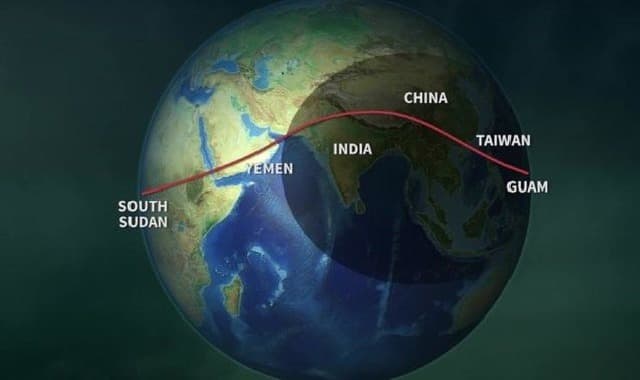
Skywatchers along a narrow band from west Africa to the Arabian Peninsula, India and southern China will witness on Sunday the most dramatic “ring of fire” solar eclipse to shadow the Earth in years.
Annular eclipses occur when the Moon — passing between Earth and the Sun — is not quite close enough to our planet to completely obscure sunlight, leaving a thin ring of the solar disc visible.

They occur every year or two, and can only been seen from a narrow pathway across the planet.
Remarkably, the eclipse on Sunday arrives on the northern hemisphere’s longest day of the year — the summer solstice — when Earth’s north pole is tilted most directly toward the Sun.
The “ring of fire” will first be seen in northeastern Republic of Congo at 5:56 local time (04:56 GMT) just a few minutes after sunrise.
This is the point of maximum duration, with the blackout lasting 1 minute and 22 seconds.
Arcing eastward across Asia and Africa, it will reach “maximum eclipse” — with a perfect solar halo around the Moon — over Uttarakhand, India near the Sino-Indian border at 12:10 local time (6:40 GMT).
More spectacular, but less long-lived: the exact alignment of the Earth, Moon and Sun will be visible for only 38 seconds.
“The annular eclipse is visible from about two percent of Earth surface,” Florent Delefie, an astronomer and the Paris Observatory, said.
“It’s a bit like switching from a 500-watt to a 30-watt light bulb,” he added. “It’s a cold light, and you don’t see as well.”
Animals can get spooked — birds will sometimes go back to sleep, and cows will return to the barn.
The full eclipse will be visible somewhere on Earth during just under four hours, and one of the last places to see a partially hidden Sun is Taiwan before its path heads out into the Pacific.
People hundreds of kilometers on either side of the centerline across 14 countries will also see light drain from the day, but not the “ring of fire.”
Weather conditions are critical for viewing.
“Good weather is the key to successful eclipse viewing,” astrophysicist Fred Espenak, an expert on eclipse prediction, commented on the NASA Eclipse website. “Better to see a shorter eclipse from clear sky than a longer eclipse under clouds.”
A solar eclipse always occurs about two weeks before or after a lunar eclipse, when the Moon moves into Earth’s shadow. Lunar eclipses are visible from about half of Earth’s surface.
There will be a second solar eclipse in 2020 on December 14 over South America. Because the Moon will be a bit closer to Earth, it will block on the Sun’s light entirely.
It will take less than 100 minutes for the path of this eclipse to move across the continent.
Even if the day has darkened, looking at a solar eclipse with the naked eye is dangerous.
Sunglasses — which don’t filter out UV rays — do not offer any protection, Delefie warned.
“The Sun is so bright that even when there’s only a tiny portion visible, it is still dangerous for the eyes,” he said.





%20Preeti%20Lobana%2C%20Sh.%20Jayant%20Chaudhary%2C%20Chris%20Phillips.jpeg&w=256&q=75)