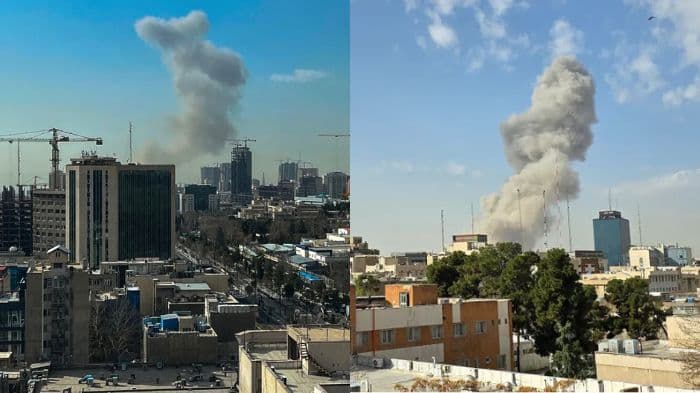
Explosions were reported in Iran’s capital, Tehran, on Feb 28 after the Israel Defense Forces said it had launched a pre-emptive strike against Iran aimed at neutralising perceived threats from Tehran’s nuclear and missile programmes.
Sirens were then heard across Tel Aviv as Israeli authorities warned of the possibility of incoming missiles and urged civilians to seek protected spaces.

According to official statements the strike — reportedly carried out with support from the United States — targeted locations near key facilities in Tehran, including areas close to Iran’s top leadership offices. Thick plumes of smoke were seen rising from the city in the aftermath of the blasts, though details on casualties remain unclear.
Israeli Prime Minister Benjamin Netanyahu said that Israel and the United States launched strikes on Iran to “remove the existential threat” posed by Tehran’s regime, which he described as a “terrorist regime” that must not be allowed to acquire nuclear weapons.
He thanked US President Donald Trump for his leadership and said the joint action was aimed at empowering the Iranian people to “cast off the yoke of tyranny”.
Netanyahu also urged citizens to comply with civil-defense instructions as the operation unfoldsIn response to the attack, the Israeli government declared a state of emergency and heightened national alert levels as the situation remains volatile.
Sirens sounded across multiple Israeli cities, particularly in central regions, prompting rapid public safety warnings and precautionary measures. Iran’s airspace was also reportedly shut down.
The escalation follows months of simmering tensions over Iran’s nuclear programme and Tehran’s ballistic missile capabilities. Both Israel and the United States have previously issued repeated warnings that military action could unfold if diplomatic efforts failed and if Iran continued advancing its strategic capabilities.
Israeli Defence Minister Israel Katz described the strike as necessary to “remove threats” to Israel’s national security, while the Israel Defence Forces issued alerts urging civilians to remain close to shelters as possible retaliatory missiles or rockets could be launched from Iranian territory.
World leaders and officials reacted strongly to the joint Israeli–US attacks on Iran, with Dmitry Medvedev, deputy chairman of Russia’s Security Council, dismissing negotiations with Tehran as a “cover operation” and saying “no one really wanted to negotiate anything.”
Lebanese Prime Minister Nawaf Salam condemned the escalation as a threat to regional security, while Norwegian Foreign Minister Espen Barth Eide criticised the strikes as not being in line with international law, saying preventive military action must meet strict criteria.