As fresh tariff escalations loom under Donald Trump’s revived trade agenda, India finds itself clinging to a fragile tariff advantage over China in the US market — while losing ground to Vietnam, a key competitor in low-cost manufacturing.
According to Fitch Ratings’ updated Effective Tariff Rate (ETR) Monitor, as of August 1, China continued to face the steepest US tariffs among major trade partners, with a total ETR nearing 42%. India, by contrast, retained a comparative advantage of approximately 20 %points, with its ETR hovering slightly above 21%.

This edge, however, is narrowing — and fast.
The concern in New Delhi is twofold: first, Vietnam has now surpassed India in tariff competitiveness following new US import duties; second, Trump’s administration has warned of a “substantial” increase in tariffs on Indian goods, citing India’s continued purchases of Russian oil and defense equipment.
In effect, India’s window to capitalize on the US-China trade rift may be closing, unless a deal with Washington is secured quickly.
“India’s advantage relies on maintaining a 10–20 percentage point buffer over China,” a senior government official told this publication. “Losing that could neutralize our competitive offset against structural weaknesses like high logistics costs, red tape, and lack of scale.”
Deal or disadvantage
Trump’s renewed threat — expected to take shape by August 7 — includes fresh duties that could upend bilateral tariff dynamics. Unlike his calibrated silence on China’s far greater Russian oil imports, Trump has repeatedly targeted India, suggesting differential treatment is very much on the table.
While India backed out of the China-led Regional Comprehensive Economic Partnership (RCEP) to protect agricultural interests, it is now under growing pressure to stitch together a limited trade pact with the US — possibly an early-harvest version.
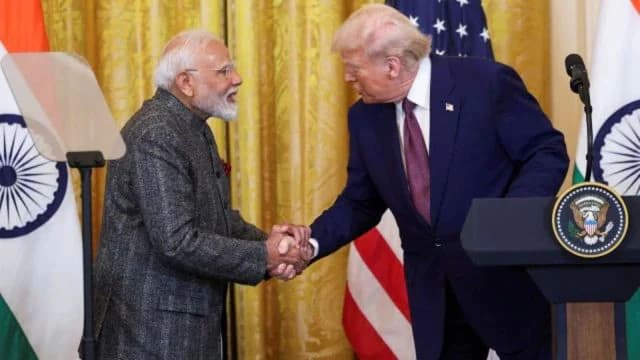
The sixth round of trade negotiations, scheduled for August 25, is seen as critical. Ministries have been tasked with identifying sweeteners to offer Washington, and an eventual breakthrough is expected to hinge on a high-level exchange between Prime Minister Modi and Trump.
“An interim deal in September is ambitious but not impossible,” said a former commerce ministry official. “Without it, India could see its export prospects dim just as global markets are tilting again.”
Strategic silence and shifting sands
China, the largest importer of Russian oil, continues to escape the sharp end of Trump’s tariff rhetoric, even as it imports nearly 2 million barrels per day — a figure close to India’s. Though both nations face risk of penalties, India appears to be under heavier scrutiny.
Adding to the pressure, the average US tariff across all trading partners now stands at 17%, an increase of 3 percentage points since June 2025, but lower than the peak levels tracked earlier this year. India’s ETR, still higher than average but lower than China’s, is no longer the insulation it once was.
Meanwhile, Vietnam has edged ahead of India in several commodity categories where Indian producers once enjoyed a pricing cushion. Despite Trump’s crackdown on transshipped Chinese goods via ASEAN countries, Vietnam’s gains have persisted, raising alarm bells in India’s policy corridors.
The narrowing gap
For India, the broader risk is this: the shrinking tariff differential may erode one of its most strategic export levers. While China remains the prime US target, its recent tariff concessions — cutting duties on American goods from 125% to 10% — suggest room for maneuver. India, on the other hand, is yet to make a similar diplomatic breakthrough.
The Indian government is closely tracking tariff burdens across US ports, particularly in sectors where Indian exporters compete head-to-head with Chinese suppliers. Officials emphasize that maintaining the 10–20% tariff buffer is crucial to counterbalance India’s higher input and capital costs.
Looking ahead
With US-China talks ending inconclusively in Stockholm last week, and only a temporary extension of the May tariff truce on the cards, India is running against the clock. Without a stopgap arrangement with Washington, the risk is no longer just economic — it’s strategic.
Experts believe that India’s best shot lies in securing a limited agreement now, and building on it in 2026, regardless of the outcome of the US presidential election.
Until then, India’s export engine — already battling global slowdown and domestic cost pressures — will be navigating uncertain terrain, where tariff advantage is increasingly a moving target.