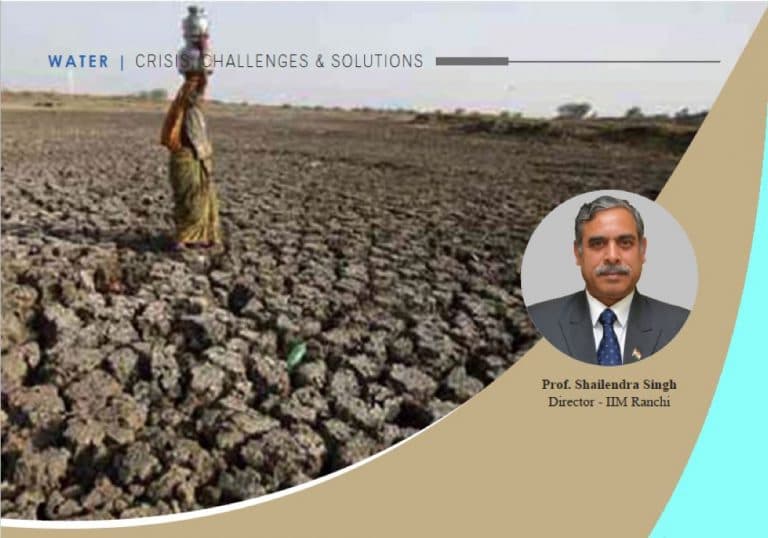
The water scarcity is primarily driven by two converging phenomena: increasing demands for freshwater use and decreasing supply of clean water due to steady depletion of usable freshwater resources. There is a physical angle to water scarcity and an economic angle as well.


The 2018 edition of the UN World Water Development report stated that nearly 6 billion peoples will suffer from clean water scarcity by 2050. This is the result of increasing demand for water, reduction of water resources, and increasing pollution of water, driven by dramatic population and economic growth.

The water crisis is a global phenomenon and India is no exception. Our water scarcity can be assessed by the fact that we house around 17 % of the world population but possess only 4% of the world’s fresh-water resources. Further, whatever fresh-water is available in India, we are not able to access the same fully.

The Gandhian approach, including his life-style is Holistic. This is in line with human ecology which visualizes human beings and their environment as constituting an integrated whole.

MSDE, Google Cloud, and CCSU launch AI-enabled university pilot in India

IIT Madras hosts international conference on water, food, and waste systems
%20Preeti%20Lobana%2C%20Sh.%20Jayant%20Chaudhary%2C%20Chris%20Phillips.jpeg&w=256&q=75)

Google launches new AI initiatives to transform learning in India

UIDAI rolls out new Aadhaar app for privacy-first age verification

Eruditus partners with seven global universities to set up India campuses

UIDAI rolls out new Aadhaar app for privacy-first age verification

SC puts 2026 UGC equity rules on hold, flags ‘vague’ caste bias definition

‘Oh s***’: Crew’s final words before Ajit Pawar’s jet went down in Baramati

Rupee sinks to record low near ₹92 per dollar despite strong growth signals

Two mid-day meal cooks die as wage hike protest escalates in Chhattisgarh
Copyright© educationpost.in 2024 All Rights Reserved.
Designed and Developed by @Pyndertech